Vornado, Stellar file formal application to build 976 new units at Independence Plaza

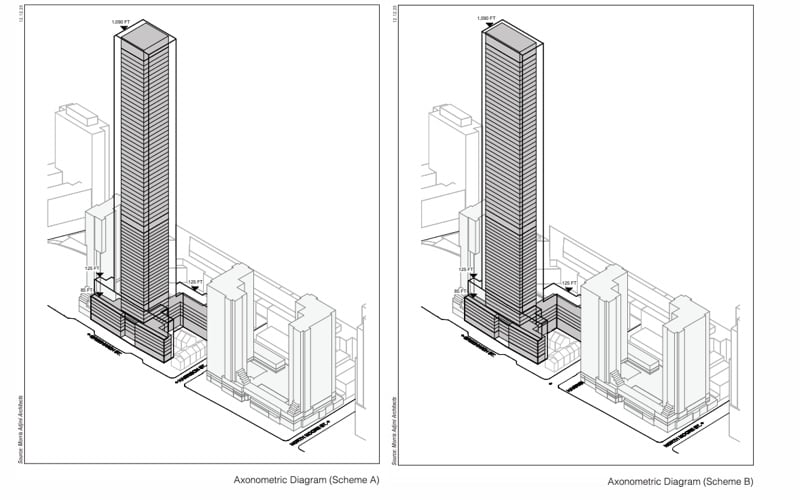
310 Greenwich Street Schemes A and B (Credit - Morris Adjmi Architects via application in DCP)

310 Greenwich Street Schemes A and B (Credit - Morris Adjmi Architects via application in DCP)

UPDATED 12:46 p.m., May 14, 2026: Vornado Realty Trust and Stellar Management filed formal applications with the city yesterday seeking approval to build 976 additional residential units in a 72-story, 1,090-foot-tall skyscraper and three much smaller “street wall” buildings, at Independence Plaza in Tribeca, Manhattan. The proposal offers one option with approximately 251 affordable units within the new construction, and the other option which would build the affordable units at some other location in Manhattan Community District 1. The development is associated with the portion of Independence Plaza known as 310 Greenwich Street.

Application 2023M0117 LINK

The filing of this Environmental Assessment Statement with the city’s Department of City Planning for the Independence Plaza complex in Tribeca marks a formal pivot in the long-running effort by Vornado and Stellar Management through their IP Mortgage Borrower LLC to densify one of Lower Manhattan’s most prominent residential footprints. This latest submission is a formal prerequisite for environmental review. The document launches the regulatory process for a project that first drew public scrutiny when initial, slightly smaller plans were disclosed in late 2023, which the Tribeca Trib reported on at the time.

This application highlights the conflict between the pursuit of high-density development and the preservation of quality of life for the site’s existing residents. Independence Plaza, which currently consists of three 39-story towers and a series of townhouses, has long been a bastion of relative stability in a neighborhood that has seen its real estate values soar to the highest tiers of the global market. The proposed tower would stand more than double the height of the existing structures, a scale that neighbors have said would fundamentally alter the neighborhood’s character.

The project is spearheaded by a partnership between Stellar Management and Vornado Realty Trust. Vornado bought an approximately 58 percent stake in the complex in 2012.  Their proposal calls for the addition of approximately 705,309 gross square feet of new construction on “Parcel 3C,” the southern portion of the development site bordered by Harrison and Greenwich Streets.

Opposition to the plan has been swift and organized. In March 2024, a standing-room-only community meeting led by Councilmember Christopher Marte signaled organized local resistance. Residents, represented by groups like the Community First Development Coalition, have raised concerns ranging from the years of construction-related noise and dust to the potential structural risk the new tower poses to historic Federal-era townhouses nearby. The tension is exacerbated by the fact that 45 existing units are slated for demolition to make way for the new tower, though the applicant has stated that any displaced residents would be relocated to other units within the complex.

The developers have options related to the Universal Affordability Preference (UAP). Both scenarios analyze the same physical massing — a 1,090-foot tower and three street-wall buildings — but they pivot on the geographic distribution of the 251 mandated affordable units.

One option represents a self-contained model where all 251 affordable units are integrated directly into the new construction on “Parcel 3C.” This is designated as the Reasonable Worst Case Development Scenario for community facility impacts, as it concentrates the specific demographic needs of income-restricted housing within the immediate project footprint.

Another option utilizes the “UAP Offsite Option,” which allows the developer to provide those 251 affordable units on a separate zoning lot within Community District 1. While the tower’s exterior dimensions remain identical, Scheme B results in a higher density of market-rate residences on-site. By filing both schemes, IP Mortgage Borrower LLC covers the full spectrum of potential regulatory paths, ensuring the Environmental Assessment Statement remains valid whether the affordability component is ultimately realized as an integrated or distributed asset.

A central point of contention involves the project’s “non-ULURP” status. Typically, large-scale developments in New York City must undergo the Uniform Land Use Review Procedure (ULURP), a multi-month public review process that requires votes from the Community Board, the Borough President, the City Planning Commission, and the City Council. The applicant argues that because the project is being developed under the site’s underlying C6-4 zoning district and does not require a waiver of any existing zoning regulations, it only necessitates a “modification” of the existing Large-Scale Residential Development (LSRD) site plan. While this path avoids a full ULURP review, the project remains subject to the City Environmental Quality Review (CEQR) process. This is why the applicant must file an Environmental Assessment Statement (EAS), which will likely lead to the preparation of a much more detailed Environmental Impact Statement (EIS) to analyze significant adverse impacts on transportation, air quality, and neighborhood character.

The proposal’s affordability component is tied to the city’s Universal Affordability Preference (UAP) program. Under this framework, the project seeks to utilize a floor area ratio (FAR) of 12.0, an increase over the base 10.0 FAR allowed in the C6-4 district, in exchange for providing a portion of the units as affordable housing. While the specific breakdown of affordability levels can vary, documents assume approximately 251 units within the project will be designated as affordable for the purposes of community facility analysis. Opponents, however, have dismissed this as “trickle-down affordability,” arguing that the vast majority of the 967 new units will be luxury residences that cater to an affluent demographic rather than addressing the city’s core housing needs. The proposal says: “the 967 new DUs on the Development Site would include 251 affordable units pursuant to the UAP,” referring to the Universal Affordability Preference, which is a key component of the New York City “City of Yes for Housing Opportunity” rules.

The broader context of the proposal is shaped by shifting city-wide policies, including the “City of Yes” initiative, which may influence how much density is ultimately permitted on the site. For now, the filing of the EAS moves the battle from the court of public opinion into the technical machinery of city bureaucracy. The analysis year for the project is currently set at 2032, suggesting a long road of environmental review and potential litigation before any shovels hit the ground. The applications say: The analysis year for the Proposed Action is 2032. This assumes that approvals would be complete by mid-2027, demolition would take 6 months, and construction would begin by early 2028, with a 48-month construction period.”

The property

The existing buildings with 1,328 residential units in Tribeca have 2,079,746 square feet of built space according to a PincusCo analysis of city data. The parcel has nine buildings with frontage of 406 feet and is 231 feet deep with a total lot size of 186,631 square feet. The lot is irregular. The zoning is C6-4 which allows for up to 10 times floor area ratio (FAR) for commercial and up to 10 times FAR for residential with inclusionary housing. The city-designated market value for the property in 2022 is $391.7 million. The most recent loan totaled $675 million and was provided by Deutsche Bank|Bank of America|Wells Fargo|Morgan Stanley on June 5, 2025.

Prior sales, articles and revenue

The 2,079,746-square-foot property generated revenue of $69.6 million or $33 per square foot, according to the most recent income and expense figures.

Violations and lawsuits

According to city public data, the property has received $27,280 in ECB penalties, 71 housing violations, $28,020 in OATH penalties, and one housing litigation in the last year.

There were no lawsuits or bankruptcies filed against the property for the past 24 months.

The neighborhood

In Tribeca, The bulk, or 47 percent of the 15.3 million square feet of commercial built space are office buildings, with elevator buildings next occupying 28 percent of the space. In sales, Tribeca has near average sales volume among other neighborhoods with $612 million in sales volume in the last two years and is the 18th highest in Manhattan. For development, Tribeca has near average amount of major developments among other neighborhoods and is the 14th highest in Manhattan. It had 3.1 million square feet of commercial and multi-family construction under development in the last two years, which represents 20 percent of the neighborhood’s built space.

The block

On this tax block, PincusCo has identified the owners of two of the three commercial properties representing 2,750,736 square feet of the 2,817,556 square feet. The two identified owners are State Of New York and Stellar Management. There are no active new building construction projects on this tax block.

The owner

The PincusCo database currently indicates that Stellar Management owned at least 79 commercial properties with 6,946 residential units in New York City with 9,547,815 square feet and a city-determined market value of $1.5 billion. (Market value is typically about 50% of actual value.) The portfolio has $3.6 billion in debt, with top three lenders as Goldman Sachs, New York Community Bank, and Morgan Stanley respectively. Within the portfolio, the bulk, or 73 percent of the 9,547,815 square feet of built space are elevator properties, with office properties next occupying 11 percent of the space. The bulk, or 86 percent of the built space, is in Manhattan, with Brooklyn next at 7 percent of the space.

The owners according to the Department of Housing Preservation and Development includes Smajlje Srdanovic, head officer and Michael Donuk, head officer. The business entity is Ip Mortgage Borrower, Llc.

The surrounding

Within a 400-foot radius of 310 Greenwich Street, PincusCo identified one commercial real estate item of interests occurred over the past 24 months. It was a sale which Gregory Spatz bought the 6,211-square-foot, five-unit mixed-use building (S9) on 385 Greenwich Street for $8.5 million from RIG Realty on August 6, 2025.

Correction: A prior version of this post indicated the two massing options Scheme A and Scheme B were related to whether 251 affordable units were included on-site or not. In fact, the two massing options are not related to the affordable units.

Direct link to the property’s ACRIS page and link to DOB NOW portal.

Share this article

Leave a Reply