Signature Bank failure repercussions: Nonperfoming loans, who benefits, immediate problems

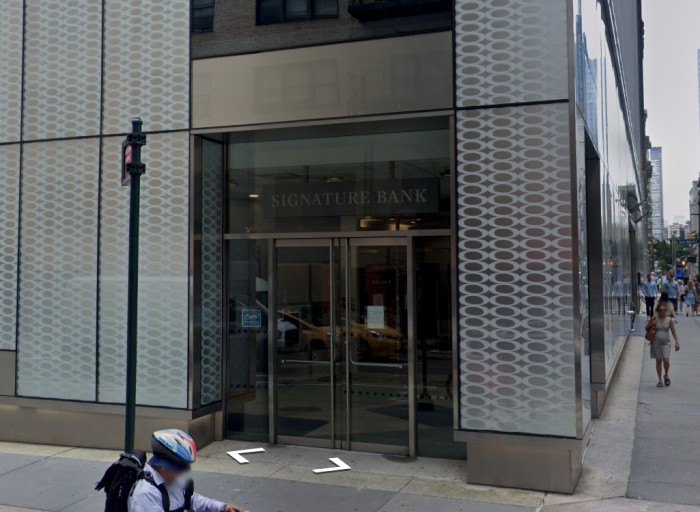
Signature Bank branch at 261 Madison Avenue (Credit - Google)

Signature Bank branch at 261 Madison Avenue (Credit - Google)

By Adam Pincus

The New York City commercial property industry spent Sunday reimagining the local lending market without Signature Bank, as it digested the news that the federal government had taken over the bank.

The most pressing issues surrounding the bank’s takeover, according to a half-dozen commercial real estate professionals, were what will happen to the nonperforming loan portfolio, who benefits from the closure, and what are some immediate impacts of the shutdown.

Signature Bank, which was closed over the weekend by regulators and is set to reopen Monday as Signature Bridge Bank, was the third most active commercial real estate lender in New York City over the past three years, with $13.4 billion in loans, according to a PincusCo analysis of property records. The analysis is based on loans of $5 million and up.

The government, according to the Federal Insurance Deposit Corportation press release, is making depositors whole and is looking to sell the bank, but that backstop did not resolve the questions swirling around the industry.

This morning, a Signature banking executive sent a note to clients and other professionals that said in part, “All depositors were made whole. All former Signature Bank employees with the exception of certain executive management are now employees of Signature Bridge Bank N.A. All loans were transferred to the new entity as well. All loan payments, rates, terms remain in effect per the loan documents.”


Nonperforming loans

Brokers, who live on transaction volume, are hoping there will be nonperforming loans to sell. Most insiders PincusCo spoke with expect the bulk of the loan portfolio will go to one bank. Some believe the new owner will hold the nonperforming loans on their books like any other loan they already had.

Others believe a new buyer will want to sell those loans. One concern from the brokerage industry is who will be able to sell the loans.

There are plenty of potential note buyers out there, but there is uncertainty about the value of the loans. Even New York City multifamily loans that are performing are in many cases considered to be under water because of two seismic events. The first was the 2019 rent law Housing Stability and Tenant Protection Act, which reduced the value of properties at which borrowers were expecting to deregulate units, and the sharp increase in interest rates last year that has continued.

Even the definition of what is considered a nonperforming loan is under discussion.

“There is a difference between a loan that is performing and underwater, and a loan that is nonperforming because [the borrower] is not making payments,” said Carlos Naudon, president of Ponce Bank, a Bronx-based community bank.

Since a loan is viewed as a bond that pays out a set rate of return, in the current high-interest rate environment, many older loans — even those that are performing — are now viewed a less valuable. That’s because the interest rates before 2022 were often under 4 percent and now they are over 6 percent. So immediately the face value of the loan would have to be cut in a note sale. In addition, the loan to value is likely far lower today than it was at underwriting because the business plan to deregulate units has likely been frustrated.

“We would be interested in buying loans but they have to be at a price that reflects the current interest rate environment and the underlying asset collateral has to make sense,” said Seth Weissman, president of private lender Urban Standard Capital.

Who benefits

Signature Bank was the third largest commercial real estate lender in New York City over the past three years, according to PincusCo data, and even if one bank takes over the whole portfolio, there is still an opportunity for smaller banks to grab a piece of the enormous pie.

“There are other lenders in this space in New York — that would include us — that would most likely benefit from the availability of multifamily lending product. I would not expect a long-term decrease in the supply. Lending institutions will move up and increase [their lending].”

Weissman expected additional business for the private lenders in part because it has discretionary capital.
“There will be tighter regulations (on the banks). Access to capital will be that much more restrictive. I think that plays to the benefit of the private capital market.”

Short-term problems

Every day another loan is scheduled to close, an employer draws down on a letter of credit to make payroll, or banks fund other types of scheduled commitments for a host of reasons.

“While I’m cautiously optimistic a buyer will be found, I am concerned about the immediate effect on NYC real estate. Signature was a very active multi-family lender, and owners with short term debt were already feeling the pinch of higher interest rates and more conservative underwriting. It’s unknown whether a successor bank will stay in that line. This puts even more pressure on borrowers, even if it creates opportunities for deeper pocket banks, investment funds and private lenders,” said Kenneth Fisher, an attorney and member of the law firm Cozen O’Connor.

David Goldwasser, a bankruptcy and distress specialist at GC Realty Advisors, said his work was impacted by the shutdown, at least in the short term. He was expecting a large sum from a settlement to be deposited, but now it will be delayed.
“I received a call from the defendant’s attorney stating the money being sent was in a Signature account, and so they were not able to uphold their agreement. They were asking for an extension due to the uncertainty about how to get the money out of Signature Bank right now.”

Share this article