More women sold NYC commercial property during Covid than bought: PincusCo analysis
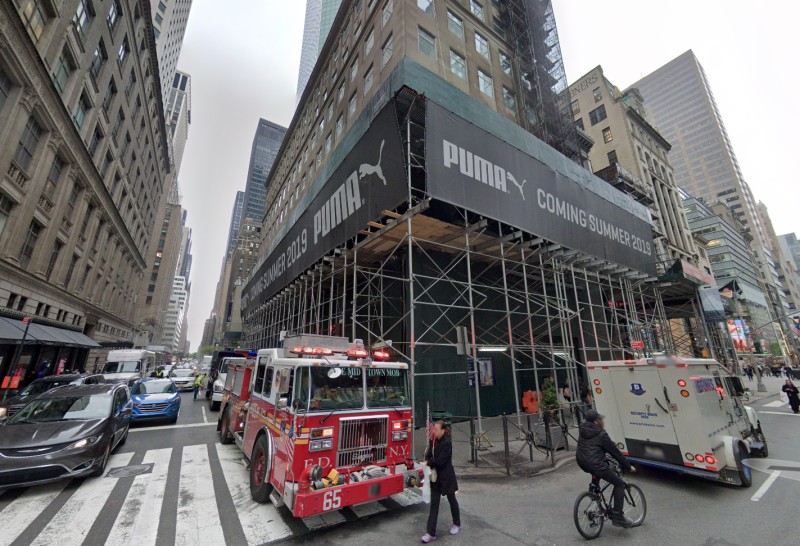
609 Fifth Avenue (Credit: Google)
By Adam Pincus
The number of women who sold commercial property in New York City was greater than the number of women who bought commercial property over the past 10 months, as the pandemic impacted transactions here and around the world.
Women as sellers signed for 83 transactions, but on the buy side, a woman was the primary signatory in only 47 transactions, a PincusCo Media review of 499 property transactions greater than $5 million found.
Top sales with women signatories included the Union Theological Seminary selling to Lendlease for $60.7 million, while top purchases with women signatories included Reuben Brothers Ltd. paying $165 million for the retail condo at 609 Fifth Avenue, as well as that same Lendlease purchase.
In addition to the net decline in ownership, the analysis underscored the male dominated landscape of commercial property. Of the 499 transactions greater than $5 million totaling $11.3 billion in the analysis, 85 percent of the seller signatories were men and they accounted for 90 percent of the total transacted value. The signatories for the buyers were 90 percent male, accounting for 87 percent of purchase value.
As for lending, men accounted for 92 percent of the 1,517 transactions totaling $43 billion of $5 million and up recorded between June 2020 and March 8, 2021 that PincusCo analyzed.
The overrepresentation of men in commercial real estate is not new, and has been widely reported. But this is the first analysis of New York City sale and loan signatories reported by the industry press. It is widely expected that the proportion of women in commercial real estate will grow, as it has in other formerly male-dominated industries.
The gender gap has been covered by The Real Deal, the Commercial Observer, The New York Times and many others.
The trade group Commercial Real Estate Women Network (CREW) issued a report last year based on a national survey of 2,930 commercial real estate professionals that found that women earned less than men and that “women hold just 9% of C-suite positions in commercial real estate.”
PincusCo chose to analyze signatories because the person signing the transfer papers is typically the decision maker of the deal, whether the owner or not. There are many exceptions, such as attorneys signing as proxies, situations with multiple owners, etc., but we believe the analysis is accurate within an acceptable margin of error and valuable despite gaps in the data. This is the first in a series of articles looking at gender in New York City real estate.
The net decline in women signatories came as the city, nation and world grappled with Covid-19 and its related lockdowns and restrictions. The unequal impact on women has been dubbed the Shecession, with women losing a greater proportion of overall jobs because service industries and retail businesses shut down.
Some of the other top deals with women seller-signatories included Haug Realty selling to the Hospital for Special Surgery for $42 million, ExxonMobil selling to Broadway Stages for $30 million and the city’s Housing Preservation and Development as led by Vicki Been, selling to Fetner Properties and Lions Group for $29.6 million.
It’s not possible to know the intent of all the sellers and there does not seem to be a pattern explaining why there was a net decrease in women signatories.
One pattern among the top sales was clear, however. There was a much higher chance a woman signatory would sell to another woman signatory among the most-expensive deals sold by women.
In six of the top 15 deals sold with women signatories, the buyers were also women signatories. That 40 percent rate for those top deals is in contrast to the overall rate of the total number of sales with women signatories, which saw just 16 percent transfer to women signatories.
Despite the low numbers of women signatories, there were dozens of women-led investment teams or firms that bought property last year, totaling $1.2 billion, including Eileen Sawyer, of the Reuben Brothers Ltd., Melissa Burch of Lendlease, Jeehae Lee of Bridge Investment Group and Lily Guo of iCross Capital.
Burch, executive general manager for New York development at Lendlease, was the signatory on two large deals, including the $110.8 million development site acquisition from JZ Capital Partners and RedSky Capital of 1 Java Street in Greenpoint, Brooklyn.
LENDING
Overall, women had a lower representation as borrowers than they did as buyers or sellers. Women made up just 8 percent of borrower signatories for loans of $5 million and up over the last 10 months.
But even as women signatories represented only a tiny minority of borrowers, they represented lenders in 44 percent of deals PincusCo tracked. That means banks and other lenders have placed women as loan officers even as their counterparties are nearly always men.
However, the data for lender signatories was much smaller than for borrower signatories, because lender-representatives rarely sign the recorded loan documents.
The top 10 deals with women borrowers totaled $1.2 billion and six of them were new construction. In contrast, new construction only represented one of the top 10 loans overall.
METHODOLOGY
PincusCo analyzed 571 commercial sales of $5 million and up recorded between June 1, 2020, and March 8, 2021. Those had a total value of $16.7 billion. From that data set, we found at least the seller signatory for 499 sales with a total consideration of $11.1 billion. Many of the other sales used types of transfers that do not include signatures, either RPTT or RPTT&RET.
PincusCo determined the gender using several online tools, as well as checking the LinkedIn for dozens of individuals to determine their apparent gender.
PincusCo recognizes that there are cases where the name is not indicative of the gender, or where the individual is binary and neither male nor female gender is accurate. Those cases are considered to be in the range of a margin of error and we determined the finding would be valuable despite those risks.
There are additional statistical barriers that increase the margin of error risk, including that signatories can be a proxy for the true owner so the gender of the signatory is not relevant, ownership can be held by both men and women, and the signature is illegible. We took the signatory as presented and when there were multiple signatories, took the first one.