It’s like Silicon Valley, but for retail: A theory on real estate and the Syrians of Brooklyn
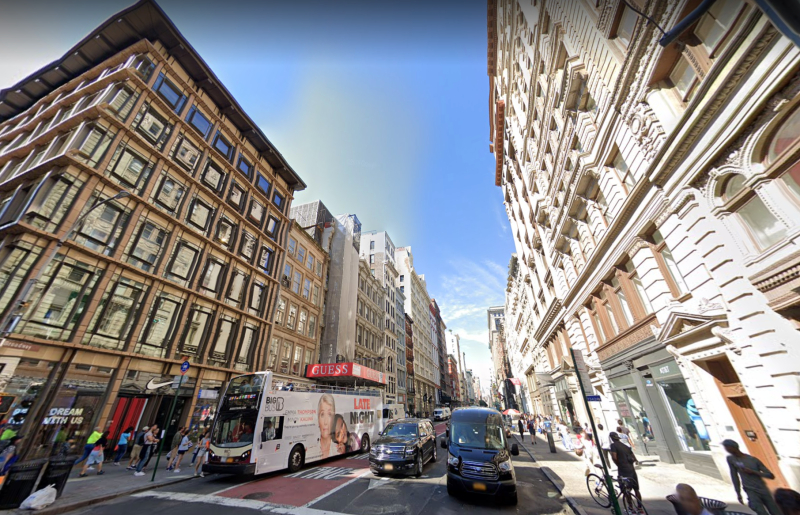
529 and 530 Broadway, looking north in Soho (Credit: Google)
By Adam Pincus
Sociologists and historians attribute the success of Silicon Valley as a tech hub to just a few factors that include specialization, the availability of capital and the freedom of movement between companies. These were all present but of course none of them unique to the area.
What was unusual is that they all happened to concentrate in one geography at one time.
Brooklyn has a curious parallel, focused not on microprocessors or software, but on retail commerce. It’s the Syrian Jewish community, known in the real estate business simply as the Syrians.
This is part of a series, called The Installment: Retail. To read other posts, click here.
Within the Gravesend neighborhood and along Ocean Parkway, as well as in the oceanside town of Deal, New Jersey, where many summer, the community is home to a clutch of real estate millionaires and at least one billionaire. They founded or manage several billion-dollar real estate portfolios and many more portfolios valued in the hundreds of millions.
But what may be a key to the success is the community’s involvement all along the retail supply chain. It starts with manufacturing and continues through importing, owning real estate, operating retail and online stores, and into brokerage and associated legal needs.
That coherent and intense interest in the greater retail world, combined with the interconnections within the insular community, and its access to bankers and capital, have resulted in a community with an outsized level of ownership in retail given its size. The community is about 75,000 people, members estimate.
The community dominates on Upper Fifth Avenue, and has a strong presence in Soho, the Meatpacking District and in top trade areas in the outer boroughs.
Firms with billion-dollar portfolios include Jeff Sutton’s Wharton Properties, the Chera family’s Crown Acquisitions, Ben Ashkenazy’s Ashkenazy Acquisition and Bobby Cayre’s Aurora Capital Associates. Joe Sitt, a member of the community, launched the global asset management firm Thor Equities that started as a local retail investor in New York City and now manages a large global portfolio. Alex Adjmi is a frequent partner on Aurora’s deals. Other families control smaller portfolios, including the Gindi family which owns retailer Century 21 and many properties; the Chehebar family’s Jackson Group, Ralph Tawil’s Centurion Realty, Jack Terzi’s JTRE, Joe Cayre’s Midtown Equities, the Sitt brothers, the Cohen family of Duane Reade, Ike Franco and Steve Kassin, and others.
To be sure, there are other impressive concentrations of property owning communities in New York City. For example there are several rent-regulated apartment owners with billion-dollar portfolios who call Borough Park home, and in Great Neck, there is a community with Persian roots which owns billion-dollar multifamily portfolios of market and rent-regulated units.
And there is no doubt that retail is hurting in New York City and beyond, with rents falling by half in some top stretches along Broadway and Fifth Avenue. And the coronavirus hovers as an additional threat to the city’s brick and mortar stores down the line.
To get a sense of how the community views this comparison, PincusCo reached out widely and spoke with ten members of the community. Several requested to speak without attribution.
A few of the individuals did not agree with the idea that the community had an outsized impact on retail, noting there were fewer than 10 very large retail players, while others attributed the success not to an ecosystem but simply to a long-running relationship with commerce of all kinds, reaching back generations.
Still another noted that with retail real estate in retreat, the community’s impact on retail was in some sense “yesterday’s news” and ticked off the top owners, noting they were in their late 50s and older. The new generation of entrepreneurs, several said, were looking to tech.
Nonetheless, the concentration of leading retail real estate companies within the Syrian community is remarkable.
Professor and author Margaret O’Mara, who wrote The Code, which is a history of the rise of Silicon Valley, said the initial isolation of the early generations in California, far from the venerable East Coast computer firms, was a factor in the region’s success. O’Mara, a professor at University of Washington, said she was not familiar with the Syrian community of Brooklyn, but said there appeared to be some parallels.
The initial isolation of these early computer tinkerers, or “guys in garages,” fostered creativity, and the specialized experience grew into what she describes as an “entrepreneurial Galapagos.”
A feature that developed around Silicon Valley was the specialized services such as venture capital law and even real estate development, that made it “locked and loaded to develop and launch,” a new company.
SPECIALIZATION
The Syrian community has been linked to retail since its early years in New York. Many who arrived were traders or store owners or became them. That experience widened until people were in all facets of the retail business.
Thirty or forty years ago, the city’s major landlord families who owned huge office and multifamily portfolios did not look at the retail as a particularly valuable asset class.
“Remember that back then it was easier to get a store. There were lower barriers to entry,” one community member said.
A handful of the community’s families launched successful retail chains, including Stanley Chera’s Young World, Joe Sitt’s Ashley Stewart, the Chehebar family’s Rainbow stores, Jack Cohen’s Duane Reade, Conway Stores, Dr. Jays, and others. The most famous in the New York area was Eddie Antar’s Crazy Eddie electronic stores, which ultimately collapsed in a fraud accounting scandal. But that was an outliner.
The tight-knit nature and the well-documented successes of prior generations feeds into a community which can result in high pressure on subsequent generations.
“There is a lot of expectation,” on each new generation to be successful, said Jake Blatter, president of KFIR Capital, a commercial brokerage firm. He is not a member of the community but interacts with it in his business.
While specialized, it’s diverse within the broad umbrella of retail. Many families were and some still are involved in clothing manufacturing, for example the Sitts, as well as the Cayres with the Cayre Group, and others. Some in the younger generation are diving back into manufacturing, including Joe Sitt’s son Joshua, a co-founder of the online streetwear brand Madhappy.
Other families worked in importing or as other professionals like attorneys or title representatives. This wide reach within a specialized segment of commerce gives any given member a slightly higher possibility of knowing someone in a corner of the business. That presents the opportunity to sharpen their knowledge, adjust pricing, alter growth plans or find a better-fitting partner, just a bit better, on average, than someone outside the community.
ACESS TO CAPITAL
A generation or two back, starting a business was less expensive.
And back a generation or two, retail had not yet become the darling of the investor class. It was, as one landlord in the community put it, “the crumbs.”
“You gave your signature on a standard form lease and filled it with goods on credit by giving your word,” one insider said.
And some, like Jeff Sutton, figured out ways to create wealth without investing much starter capital. For instance on many of his early deals in the boroughs, he identified a space, then found a tenant who wanted it, then inked an in-between lease, in which he earned the spread between what he paid the landlord and what the tenant paid to him.
In addition, some of the families made fortunes in other industries. Joe Cayre, founder of Midtown Equities, and his brothers Stanley (father of Bobby Cayre) and Ken founded the successful Latin music label Salsoul Records in 1976, and later they founded a VHS production company that distributed films to Wal-Mart. Those and other endeavors provided capital for real estate.
Other avenues to financing were traditional banks as well as relationships with the international Syrian community and bankers such as the Safra family.
FREE FLOW OF IDEAS
Taking advantage of the community’s specialization requires the free flow of information between community members. In Silicon Valley, that was assisted because California does not recognize non-compete clauses in contracts. That allows programmers, entrepreneurs and others to move quickly from company to company, and with each move carry fresh knowledge to the new company much faster than in a state like New York where a non-compete would prevent sharing intelligence for months or years.
And a hallmark of the Syrian community is its interconnectivity. That’s in part because of its insular nature But it’s also a community that favors community-focused groups.
The Syrians also host large gatherings. For example Jeff Sutton, of Wharton Properties threw a wedding in Italy in 2017 for one of his daughters that cost millions to fly hundreds of guests over, host them and entertain them.
That’s not an isolated event. A large contingent for many years vacations each January in Aruba. And the tight community revolves around summers in Deal, and other social events, nonprofit fundraisers and religious holidays.
While today one of the guiding principals is that the younger generation should go out and get a job on their own, many enter the family business or reach out to a family friend for an entry-level job.
Dr. David Sitt, a distant cousin to Joe Sitt and Sitt brothers Ralph and Eddie, said it is not unusual for him to receive invitations to three weddings set for a single week. Each wedding may have hundreds of people, bringing together investors and retailers and manufacturers in what he called, “a funky interconnectedness.”
Dr. Sitt is a clinical psychologist and corporate consultant, and professor at Baruch College, who also plays a role in managing his family’s real estate company Blake Road Realty, which has holdings in Boston, New York and Florida.
He said along with intense competition — which he said was most notable in real estate — there is a powerful network of support among the Syrians. The attitude is “ultimately we are one community, we are in it together.”
Update: Direct quotes were removed in several instances.