
LPC criticizes TZ Capital’s window plans for 680 Madison retail, bought for $180M
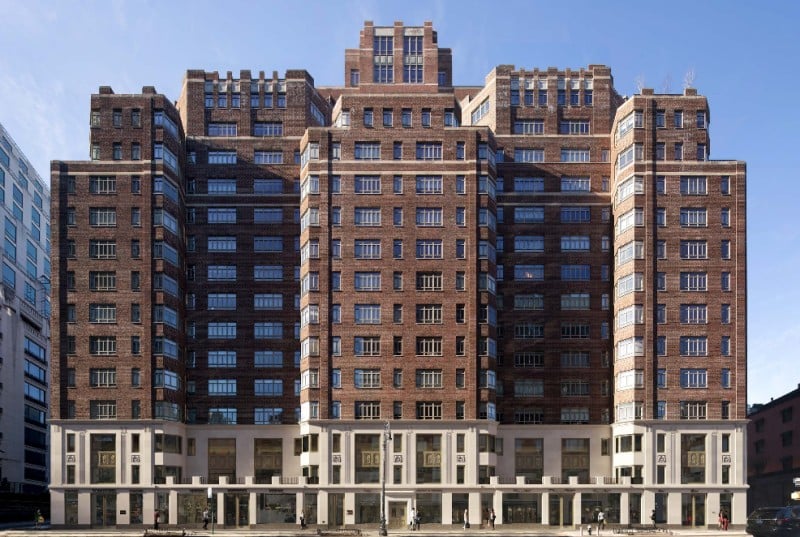
680 Madison Avenue retail rendering (Credit - Higgins Quasebarth & Partners via LPC)
The New York City Landmarks Preservation Commission stopped short of approving TZ Capital‘s extensive master plan to redefine the retail base of 680 Madison Avenue, in Lenox Hill, opting instead to take “no action” on the application during a commission meeting on April 7, 2026, until the developer revises its approach to window openings, scale, and signage. The proposal, which seeks to govern the installation of storefront infill, windows, and signage across the three-story Neo-Georgian base of the Carleton House, came before the Commission following TZ Capital’s purchase of the retail condop unit in 2024, reflecting the ongoing push for wider openings in high-end Madison Avenue retail.
LPC-26-08308 application LINK
Florida-based TZ Capital bought the retail for $180 million from Thor Equities and CenterSquare Investment Management in May 2024, borrowing $120 million from Goldman Sachs at the time.

Speaking for the ownership, Tyler Tananbaum of TZ Capital told the commission that the existing design, “does not fully meet our retailers’ needs and desires” for light and visibility, which he called, “critical to keeping this section of Madison Avenue viable as a retail destination.” Lindsay Peterson of the architecture firm Higgins Quasebarth & Partners, representing the applicant, said that they were “not removing any historic fabric,” as the existing spandrels are non-historic fiberglass, and that the new design sought to unify the base by drawing inspiration from its one remaining historic detail, a nickel-finish entry surround. To support the shift toward larger glass openings, the team cited comparable precedents, including a neighboring full-block apartment building with “much larger openings at its first floor,” as well as the LPC’s approval for combining and enlarging openings at 828 Madison Avenue.
The proposal received strong public backing from the local business improvement district. Matthew Bauer, president of the Madison Avenue BID, supported the application, stating the design would “aid in retail visibility,” and strengthen the pedestrian-friendly horizontal sign band.
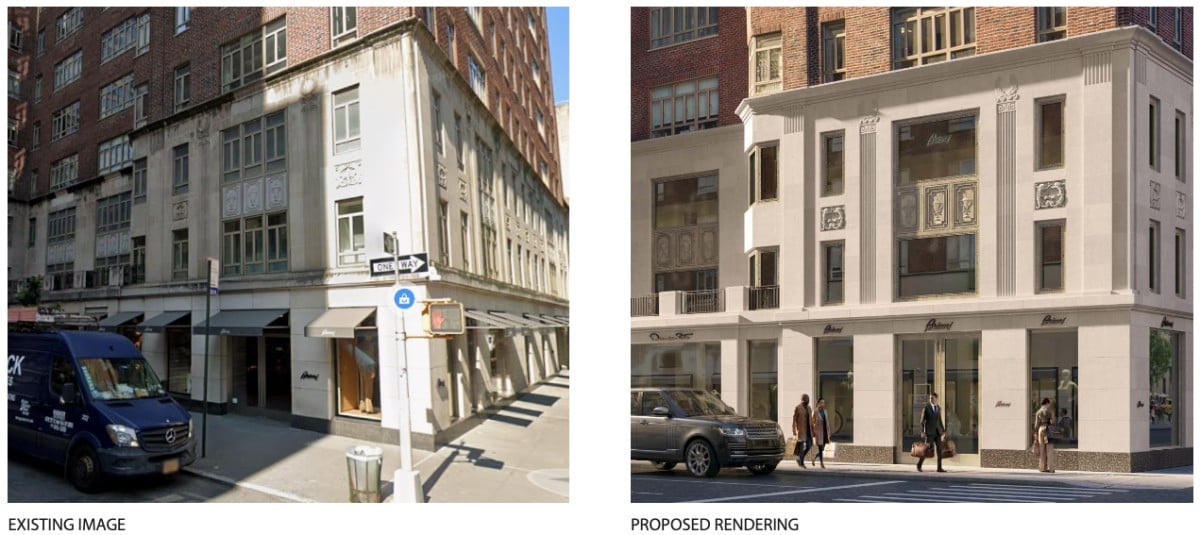
However, preservation groups and commissioners alike voiced concerns over the plan’s impact on the building’s architectural integrity. Emma Bartley of the Historic Districts Council objected, saying enlarging the ground floor masonry openings would “compromise the building’s carefully balanced composition” and erode the effect of the existing strong, substantial base.
Zeynep Turan of Friends of the Upper East Side was even more forceful in her objection, stating the proposal introduced an “excessive degree of glazing. ” Turan also expressed concern that replacing the second- and third-floor casement windows with single-pane units would create a visual disconnect, undermining the structure’s cohesive neo-Georgian design.
The Commissioners’ discussion focused heavily on fears of visual clutter that may be created by the number of proposed pin-mounted letters on the stone facade. Commissioner Frank Mahan opposed the quantity of signage, stating what was proposed was “simply too much” and degraded the sense of clarity, while Commissioner Stephen Chu worried the pin-mounted signage would become a “messy condition” and suggested it should instead be confined within the window openings. Commissioner Michael Goldblum agreed, recommending the applicant explore alternatives like a “rail system” or decals in the windows to modulate the signs.
On the architectural merits, Commissioners raised concerns about the new scale. Commissioner Chu noted a “loss of sense of detail and scale” and found the enlarged openings to be “a bit too contrasting” with the windows on the floors above.
Focusing on the recessed bays, Commissioner Erasmus Ikpemgbe believed these sections were widened “a little too wide” and suggested separating the glazing into a tripartite area to help restore cohesion to the base. Commissioner Goldblum echoed this sentiment, finding the rhythm of the infill glazing “unsettling” due to its irregularity, and suggested looking back at original renderings to regularize the glazed areas. Furthermore, Commissioner Everardo Jefferson felt the design “falls apart” in the recessed areas, which looked like “two large windows placed,” and recommended adding more mullions to make those windows look “more denser-looking” and cohesive with the rest of the facade. Commissioner Wellington Chen also raised a practical concern regarding the plan’s long-term implementation, noting that the proposed phasing of work as leases expire could lead to a lack of “uniformity or the unity of over time for the next decade.”
Given the extensive critiques, the LPC determined that the master plan requires revisions, resulting in the “no action” ruling and sending TZ Capital back to the drawing board to address the balance of solidity, signage, and scale before returning to the Commission.
The neighborhood
In Lenox Hill, The bulk, or 34 percent of the 53.3 million square feet of commercial built space are elevator buildings, with specialty buildings next occupying 30 percent of the space. In sales, Lenox Hill has the highest sale turnover among other neighborhoods in the city with $4.9 billion in sales volume in the last two years. For development, Lenox Hill has near average amount of major developments among other neighborhoods and is the 25th highest in Manhattan. It had 1.7 million square feet of commercial and multi-family construction under development in the last two years, which represents 3 percent of the neighborhood’s built space.
The surrounding
Within a 400-foot radius of 680 Madison Avenue, PincusCo identified 19 commercial real estate items of interests occurred over the past 24 months. Of those 19 items, one was for major renovation including a certificate of occupancy change. It was a permit application filed on May 12, 2025 for the $2 million renovation of 10,522-square-foot 56 building with zero residential units at 694 Madison Avenue. Of those 19 items, 11 were sales above $5 million totaling $1.3 billion. The most recent of the 11 was Richemont which bought the 6,620-square-foot, one-unit mixed-use building (K4) on 690 Madison Avenue for $54.5 million from SL Green Realty and Wharton Properties on March 3, 2026. Of those 19 items, seven were loans above $5 million totaling $1.1 billion. The most recent of the seven was Patrick Y. Lee in which borrowed $31.9 million from City National Bank secured by one condo unit in the 12,658-square-foot, 72-unit mixed-use building (RM) on 26 East 63rd Street on January 8, 2026.
Direct link to the property’s ACRIS page and link to DOB NOW portal.