
LPC approves Lonicera Partners’ 8-foot cantilever over walkup in NoHo historic district
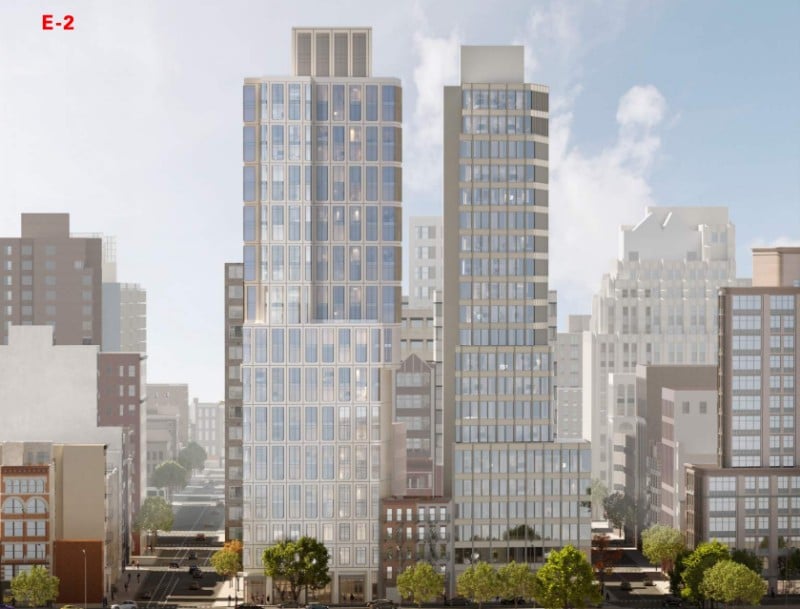
56 Great Jones Street rendering (tower on the left) (Credit - Fogarty Finger Architecture via LPC)
The Landmarks Preservation Commission approved plans by Lonicera Partners to construct an eight-foot cantilever over the building at 354 Bowery which is in the NoHo Historic District Extension. The cantilever is a feature of the developer’s proposed mixed-use condominium high rise at 56 Great Jones Street, which is just outside the historic district.
The commission approved the project with an 8-to-1 vote at the public meeting on April 7, 2026.
The cantilever is a key structural element of 56 Great Jones Street, also know as 348 Bowery, which benefiting from the area’s 2121 SoHo/NoHo special district rezoning. The cantilever is projected to add slightly over 5,000 square feet to the project, a crucial factor cited by the applicant. Chris Fogarty, representing Fogarty Finger Architecture, noted that the increased area would allow them to raise the number of affordable units from 27 to 30.
John Evans, managing principal of Lonicera Partners, submitted a new building construction project for an 88-unit, 203,627-square-foot mixed-use residential (R-2) building at 56 Great Jones Street in Noho, Manhattan. The plan was filed with the New York City Department of Buildings on December 30, 2025 under job number M01335408. It calls for the construction of a 25-story building. The project is described in the filing as: application filed for construction of mixed use new building.

Lonicera Partners has been assembling the site, as first reported in 2025 by PincusCo.
The historic five-story building at 354 Bowery, an Italianate-style multiple dwelling dating back to the 1830s, sits midblock on Bowery between Great Jones Street and West 4th Street. The cantilever’s design attempts to acknowledge the neighborhood’s architecture, with Fogarty Finger Architects stating they took inspiration from the “corbels and the brackets of some of these massive cornices that happen all over the neighborhood” to deal with the transition of the massing.
The approval vote resolves a situation from a previous public hearing on February 24th, 2026, where the application (LPC 26-06533) was initially brought before the Commission. At that time, a “no action” was taken, not due to opposition, but because there were insufficient commissioners present to vote, despite most expressing a consensus of support.
In the final discussion, commissioners focused on the limited visual impact of the structure, which begins approximately 71 feet above the historic building’s roof. Commissioner Frank Mahan noted that the projection was “quite modest and subtle, especially when compared to other cantilevers that have been approved by the Commission in the past”. Commissioner Ginsburg agreed, stating the cantilever was “very high up, and I don’t find that it distracts from the historic district”. Commissioner Chen found the alternative—a sheer, straight-up wall on the adjacent building—to be “even more monotonous” in the context of the specific site.
The lone opposing vote came from Commissioner Goldblum, who argued that the structure violates a critical urban typology. He stated that the cantilever “breaks that and creates a different figure against the sky that is non-historic and does not enhance the district,” challenging the core principle “that sides are sides and fronts are fronts” in New York City.
The LPC ultimately voted 8 in favor to 1 opposed to grant the Certificate of Appropriateness. The approval, however, was conditioned on modifications requested by the Commission. Specifically, the applicant must work with staff to refine the detailing of the gap between the new construction and the historic buildings. This “gasket piece,” caused by the significant lean and settlement of the historic structures, requires further study on its “configuration, color, and materiality of the gasket piece both at the front facade and the roof”. The LPC aims to ensure the required infill treatment does not exacerbate the visual awkwardness of the exposure.
The neighborhood
In NoHo, The majority, or 55 percent of the 3.8 million square feet of commercial built space are office buildings, with elevator buildings next occupying 14 percent of the space. In sales, NoHo has near average sales volume among other neighborhoods with $113.9 million in sales volume in the last two years and is the 37th highest in Manhattan. For development, NoHo has near average amount of major developments among other neighborhoods and is the 42nd highest in Manhattan. It had 263,238 square feet of commercial and multi-family construction under development in the last two years, which represents 7 percent of the neighborhood’s built space.
The block
On this tax block, PincusCo has identified the owners of 13 of the 17 commercial properties representing 132,288 square feet of the 174,461 square feet. The largest owner is Anthony C. Marano, followed by Edward J. Minskoff Equities and then Eric Goode. On the tax block, there were two new building construction projects totaling 234,633 square feet. The largest is a 88-unit, 135,845 square-foot residential (R-2) building submitted by Lonicera Partners and filed by John Evans with plans filed December 30, 2025 and it has not been permitted yet. The second largest is a 98,788 square-foot business (B) building submitted by SK Development and filed by Scott Shnay with plans filed January 7, 2021 and permitted December 8, 2022.
The owner
The PincusCo database currently indicates that Lonicera Partners owned at least 16 commercial properties with 793 residential units in New York City with 277,993 square feet and a city-determined market value of $83.9 million. (Market value is typically about 50% of actual value.) The portfolio has $400.3 million in debt, with top three lenders as Santander Bank, City National Bank, and Santander Bank respectively. Within the portfolio, the bulk, or 51 percent of the 277,993 square feet of built space are elevator properties, with development properties next occupying 13 percent of the space. The bulk, or 91 percent of the built space, is in Brooklyn, with Manhattan next at 7 percent of the space.
The surrounding
Within a 400-foot radius of 348 Bowery, PincusCo identified nine commercial real estate items of interests occurred over the past 24 months. Of those nine items, one was in new building development. It was a new building permit application filed on February 5, 2026 for a 21,886-square-foot 56 building at 27 East 4th Street. Of those nine items, four were sales above $5 million totaling $34.2 million. The most recent of the four was Donna Lennard which bought the 5,442-square-foot, five-unit mixed-use building (K4) on 51 Bond Street for $5.8 million from Joseph Raimondo and Charles Raimondo on November 10, 2025. Of those nine items, four were loans above $5 million totaling $63.3 million. The most recent of the four was Joseph Brunner in which borrowed $7 million from Metropolitan Commercial Bank secured by the 12,385-square-foot, two-unit hotel (HH) on 338 Bowery on August 5, 2025.
Direct link to the property’s ACRIS page and link to DOB NOW portal.